
Québec is raising the bar for Class 1 heavy vehicle drivers. As of December 15, 2025, anyone seeking a tractor-trailer license must complete the Québec-enriched heavy vehicle driver training program—a mandatory curriculum aligned with National Safety Code Standard 16. This change reflects Canada’s commitment to safer roads and better-prepared commercial drivers.
This article answers the key questions: who this program is for, what it includes, how long it takes, what it costs, and how to access financial assistance in Québec. Whether you’re a person considering a career change or someone already in the transportation sector looking to upgrade, this guide will help you determine your next steps. The training targets future tractor-trailer and other heavy truck drivers who want to work safely on Québec and Canadian roads, with content verified against the Highway Safety Code and guidelines from the Société de l’assurance automobile du Québec (SAAQ).
Regulatory Context and Standard 16
Following a series of high-profile collisions involving heavy vehicles in 2018-2019, Canada’s transportation authorities recognized that novice commercial drivers often lacked standardized training in critical skills—air brake systems, coupling and uncoupling procedures, and handling in adverse weather. These discussions prompted federal action.
In 2020, the Council of Ministers Responsible for Transportation and Highway Safety approved National Safety Code Standard 16, establishing minimum training requirements for Class 1 drivers across Canada. Key elements include:
A baseline of 112 training hours, combining theory and practical instruction
Mandatory competencies in air brake operation and cargo securement
Requirements for defensive driving and emergency response training
Evaluation standards that providers must meet for certification
Québec integrated these mandatory Class 1 training provisions into the Highway Safety Code in 2024. However, the Ministère des Transports et de la Mobilité durable delayed full enforcement until December 15, 2025, giving training centers time to upgrade facilities, curricula, and instructor qualifications.
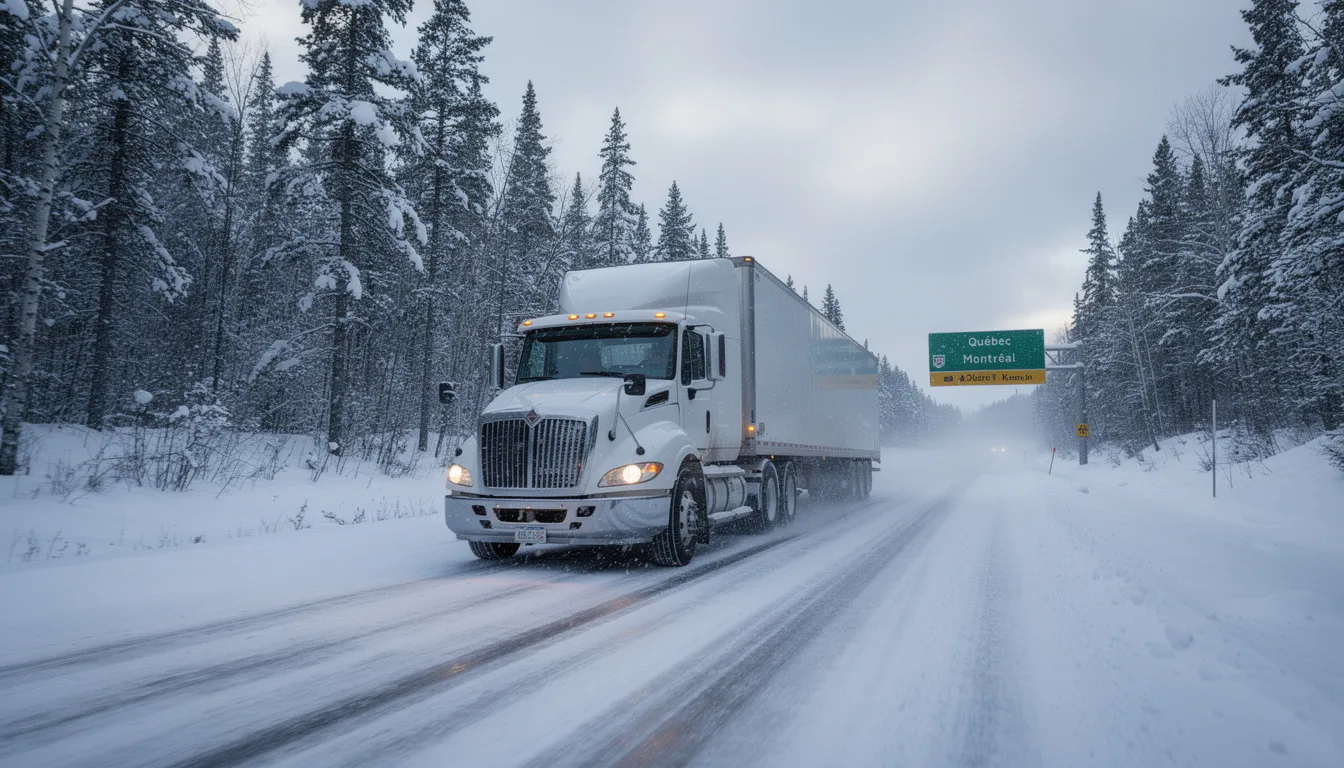
The enriched Québec program meets or exceeds Standard 16 in hours, competencies, and safety content. For instance, Québec-specific modules include winter driving simulations on icy, closed courses—a critical addition, given that black ice and snow account for over 20% of heavy-vehicle incidents annually in the province.
Key Implementation Dates in Québec
The mandatory enriched Class 1 training program will officially take effect in Québec on December 15, 2025. This date marks a significant shift in how new commercial drivers obtain their licences.
Before December 15, 2025: Candidates can still follow existing Class 1 training paths. However, both the SAAQ and the Ministère des Transports et de la Mobilité durable strongly recommend choosing programs that are already aligned with Standard 16. Information bulletins released in late 2024 and early 2025 provide content on recommended providers and curriculum expectations.
On and after December 15, 2025: No new Class 1 heavy vehicle licences will be issued to drivers who have not completed an approved mandatory program. The only exceptions apply under specific transitional clauses—for example, candidates who passed their road tests before the cutoff or who hold equivalent experience may qualify for exemptions.
Regulatory details continue to be published by the SAAQ and the Ministère des Transports. As of the last regulatory updates available at the time of writing (November 2025), the official provider lists and attestation processes have been confirmed. Customers seeking Class 1 licences should monitor official government pages for any changes.
Structure of the Enriched Class 1 Heavy Vehicle Training
The enriched program follows a competency-based framework that blends theoretical instruction with hands-on practice. Rather than simply logging hours, students must demonstrate proficiency in specific skills before advancing.
The approximate total duration ranges from 125 hours for the PESR – Class 1 (Road Safety Education Program) to 615 hours for the Diploma of Vocational Studies (DVS/DEP) in Trucking. Québec tends to exceed the national minimum in several modules, particularly those related to winter driving and technology integration.
Training typically unfolds across several blocks. Classroom theory covers Québec’s Highway Safety Code, federal Commercial Vehicle Drivers’ Hours of Service Regulations, and vehicle dynamics principles—such as how load shift affects tractor-trailer stability during high-speed lane changes. Students learn to manage logbooks, understand cargo securement protocols under the National Safety Code, and calculate stopping distances using formulas that account for reaction time, speed, and deceleration rate.
Simulator training, when offered, allows students to practice high-risk scenarios without real-world consequences—rollover prevention, brake fade under heavy loads, and emergency maneuvers. Closed-course exercises then build competence in pre-trip inspections, air brake adjustments, and precision maneuvers like alley docking and off-tracking compensation.
On-road sessions progress to urban congestion navigation, highway merging at 100 km/h, and—where conditions permit—actual winter driving. Environmental considerations also feature prominently: students learn fuel-efficient practices, such as reducing aerodynamic drag through speed governance.
Mandatory Training Programs Offered in Québec
As of December 15, 2025, two main pathways will exist to obtain the Class 1 license through enriched training. Both must be recognized by the SAAQ and meet Standard 16 criteria, including minimum in-cab hours and evaluation standards aligned with CVSA guidelines.
Pathway 1: Road Safety Education Program (PESR – Class 1)
This comprehensive full-time program typically spans 2-4 weeks, with an intensive daily schedule of 6-8 hours. The PESR – Class 1 totals a minimum of 125 hours—75 in theory and 50 in practical in-cab instruction. It’s designed for career switchers who want to enter the workforce quickly. Training centers like Center de formation en transport de Charlesbourg (CFTC) and Center de formation en transport routier (CFTR) offer this format.
Pathway 2: Diploma of Vocational Studies (DVS/DEP) in Trucking
The DVS extends to 615 hours, including 230 practical hours. This modular or part-time program covers the same competencies but is designed for working adults or those who require more flexibility. The curriculum spans 6-9 months and includes additional mechanical aptitude training—diagnosing hydraulic failures, for example—that the shorter PESR may not cover in depth.
Program | Duration | Theory Hours | Practical Hours | Format |
|---|---|---|---|---|
PESR – Class 1 | 2-4 weeks | 75 | 50 | Full-time intensive |
DVS/DEP Trucking | 6-9 months | 385 | 230 | Modular/part-time |
The practical differences matter for students. The PESR suits those who can commit to full-time study and want rapid entry into employment. The DVS offers greater depth and may be preferred by employers seeking candidates with stronger mechanical foundations. Neither pathway promotes specific schools over others—what matters is SAAQ recognition.
Eligibility Requirements for Enriched Class 1 Training
Candidates must meet basic conditions before enrolling and being authorized to drive heavy vehicles in Québec. These prerequisites apply regardless of which training pathway you choose.
Standard prerequisites include:
Minimum age of 18 years
Valid Class 5 driver’s licence (probationary acceptable for youth-enriched variants)
Clean driving record free of demerit points, suspensions, or revocations in the prior two years
Medical fitness certification per SAAQ standards, evaluating vision (20/30 acuity), hearing, cardiovascular health, and absence of conditions like uncontrolled epilepsy
Many training centres impose additional requirements. Candidates may need to pass an admission interview or basic aptitude checks—literacy for reading logbooks, numeracy for weight calculations (e.g., axle load limits under 10,000 kg per steering axle), and mechanical reasoning assessments.
Some providers request criminal background checks for insurability purposes, especially for hazardous materials endorsements or U.S. cross-border transport under FAST program protocols. Meeting these conditions does not guarantee a job—a driver shortage estimated at 25,000 vacancies nationwide doesn’t mean automatic employment—but it is mandatory for licensing and for accessing most financial assistance measures.
Financial Assistance for the Class 1 Road Safety Education Program
Financial aid of $1,425 per person is available for eligible full-time participants in an SAAQ-recognized Class 1 Road Safety Education Program. This assistance helps offset training costs but does not cover all tuition and living expenses.
Conditions for receiving the $1,425 assistance:
Training must be completed in full at a recognized provider
Candidates must submit the official course attestation to Services Québec
Required documents (ID, proof of residence, and training confirmation) must accompany the request
This assistance can complement other funding sources. Emploi-Québec measures may cover up to 100% of tuition for unemployed claimants. Low-interest loans through La Financière des PME, employer-sponsored reimbursements averaging $5,000-$10,000 for vetted hires, and bursaries from unions like Teamsters Québec provide additional options.
However, against PESR tuitions of $4,000-$6,000 or DVS fees up to $12,000, including equipment, the $1,425 covers only a portion of the costs. Rural residents may also face travel expenses not fully subsidized. Readers should verify the most recent amounts and eligibility rules on official Québec government portals, as figures may be updated annually.
How to Request Employment and Financial Assistance in Québec
Candidates can obtain personalized help from Services Québec and employment assistance services to finance their enriched training. The process begins with meeting an employment assistance officer.
At a Services Québec office, the officer reviews your situation—unemployed, worker, in requalification, newcomer—and proposes appropriate programs. They help determine which measures apply to your profile and assemble a financial package combining various supports.
Common profile examples and possible support paths:
Profile | Potential Assistance |
|---|---|
Laid-off manufacturing worker | Requalification subsidies up to $500/week, $1,425 SAAQ aid |
Young person on social assistance | Training stipends of $700/month plus childcare vouchers |
Newcomer with driving experience abroad | Equivalency bridging grants under $2,000, licence validation support |
The officer may help combine training allowances, transportation reimbursements ($0.50/km), childcare support, and the $1,425 specific assistance when applicable. Preparation speeds up the process—gather your ID, CV detailing prior safe driving experience, proof of residence, and previous diplomas before your appointment. Processing for funding disbursement typically averages 2-4 weeks after enrollment confirmation.
Requesting Information and Services Online
Many Québec residents prefer starting their request for information or assistance online. The provincial government provides secure portals for this purpose.
People can log in to “My Account — Employment Assistance — Social Assistance” on the official government portal to submit a request for employment services and training-related financial aid. This app-like interface offers several advantages:
Ability to upload documents securely
Real-time tracking of request status
Notifications when updates occur
Secure messaging with your assigned caseworker
According to 2025 government statistics, 70% of Québec users now access these services online, reducing office visits amid high demand. Before creating an account, have your social insurance number and contact details ready.
Other Ways to Obtain Information and Apply for Assistance
Not everyone has reliable internet or feels comfortable using online tools, so alternative channels remain important in Québec. Over 150 Services Québec locations province-wide offer in-person support.
Available alternatives:
In-person visits: Employment assistance organizations and Physical Services Québec counters provide face-to-face support. Staff can help fill out forms, answer questions, and verify eligibility on the spot.
Phone inquiries: Contact government information lines, such as 1-877-767-8773, for eligibility pre-screening before traveling to an office.
Community organizations: Immigrant support centers and literacy groups often help future drivers understand requirements and paperwork in plain language—particularly helpful for reviewing complex attestation processes.
These alternative channels handle approximately 30% of cases, proving crucial in remote areas like Abitibi, where internet unreliability affects 15% of applicants. Organizations helping customers navigate the system are satisfied when they can provide content in multiple formats to meet diverse needs.
Information verified as of November 7, 2025.
Career Prospects After Completing the Enriched Program
The SAAQ projects a shortage of 4,000 Class 1 drivers in Québec by 2026, fueling strong demand across multiple sectors. Graduates of the enriched program enter a job market eager for qualified candidates.
Typical entry-level roles include:
Local deliveries in urban centers
Regional routes between Québec and Ontario ($25-$35/hour starting)
Long-haul transportation (e.g., Montréal-Toronto runs paying $0.60-$0.80/km)
Tanker and flatbed operations with additional MELCC certifications
Work with logistics and retail distribution fleets
Graduates of the enriched program are generally preferred by employers because of standardized safety training and proven skills in maneuvering, inspection, and regulatory compliance. Carriers like Transport Grayson specifically seek candidates with knowledge of CVOR compliance and winter traction control experience.
Entry salaries typically range from $55,000 to $70,000 annually, rising to $90,000+ after one year of clean driving. However, the profession presents challenges: irregular schedules with 12-hour shifts, time away from home, and managing fatigue under 14-hour daily caps. Continuous training—TDG hazardous materials certification every three years, winter driving refreshers—keeps skills current.
Beyond licencing, professional attitude, a safe driving record, and ongoing learning are key to career progression. The professionalization enabled by these programs also helps curb unlicensed operations that were implicated in 15% of 2024 crashes.
Summary and Next Steps for Future Class 1 Drivers
The Québec-enriched heavy vehicle driver training program represents a significant step forward for road safety and driver professionalism. Mandatory as of December 15, 2025, the program aligns with National Safety Code Standard 16, offers two recognized formats (PESR and DVS), and connects to financial and employment assistance measures through Services Québec.
Your next steps:
Check prerequisites: valid Class 5 licence, clean driving record, medical fitness
Compare recognized training centres in your region—verify SAAQ recognition
Budget for tuition ($4,000-$12,000) and living costs, factoring in available assistance
Schedule a meeting with an employment assistance officer to explore funding options
Keep copies of all documents in a dedicated folder for licence application and job search
The Québec-enriched heavy-vehicle driver training program is designed to improve road safety, professionalize the trade, and create sustainable career opportunities. With strong demand for qualified drivers and structured support available, now is the time to plan your path to a Class 1 licence.
Test yourself with the Quebec Heavy Vehicle Practice Test study questions until you can explain the concepts clearly without looking at the notes.