
Ontario’s Class A Overhaul Arrives January 1, 2027: How to Plan Your Licence Around the New Rules
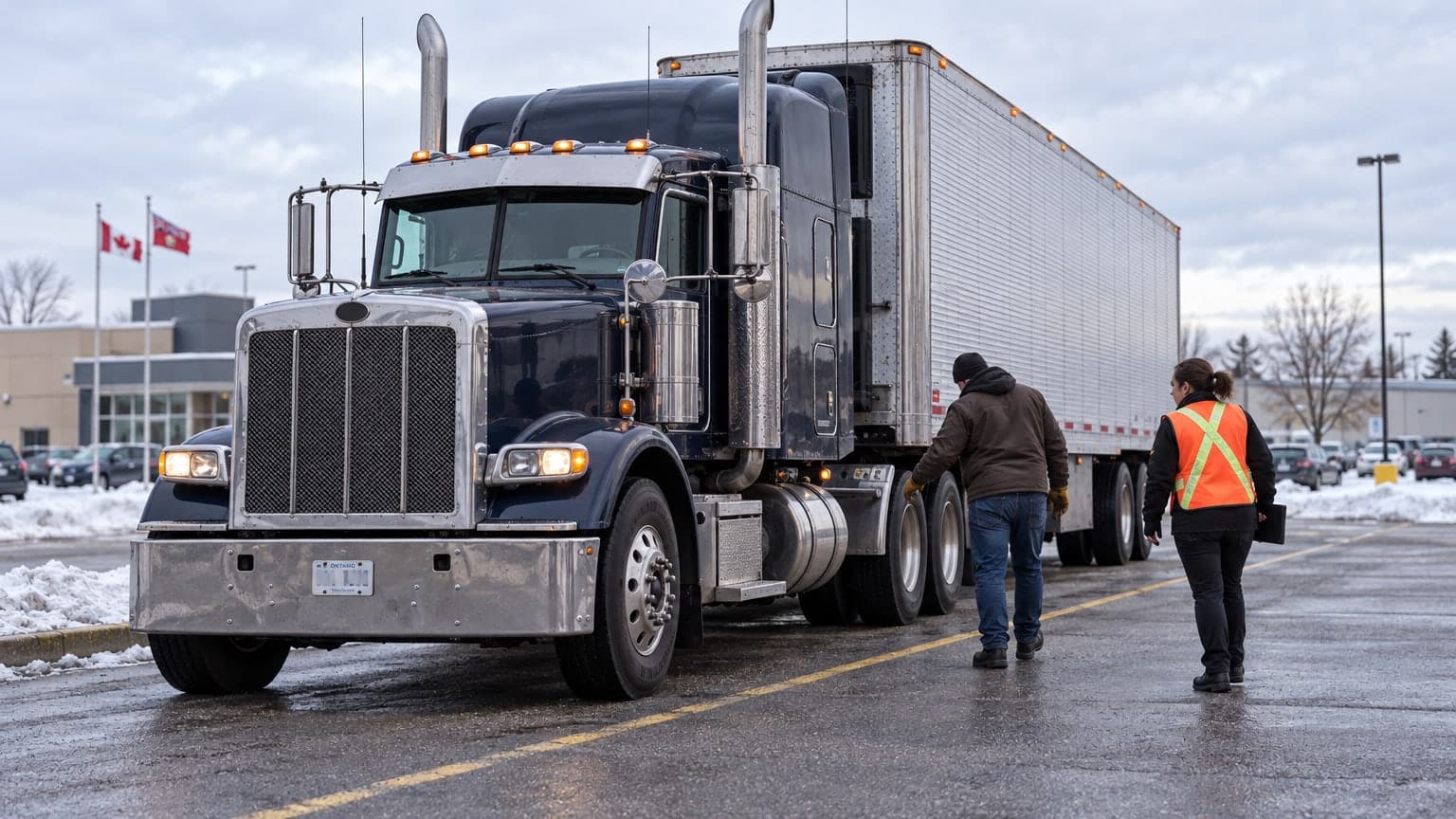
Starting January 1, 2027, Ontario will refuse to let you take a full Class A road test until you have held a full Class G licence (or a higher class that permits Class G vehicles) for at least six months. The Ministry of Transportation announced the requirement in June 2026 and bundled it into a wider overhaul on September 21, 2026: a standardized entry-level curriculum every training school in the province must follow, a dedicated integrity manager for truck driver testing, weekly reviews of training schools, and documentation proving eligibility to work in Canada.
Some of this is already in force. Since May 11, 2026, applicants and renewing drivers must show residency and lawful-presence documents. Since July 1, 2026, foreign driving experience counts for at most 12 months, and applicants from non-reciprocal jurisdictions must pass both G2 and G road tests with a mandatory year between them.
Planning a Class A licence in Ontario right now comes down to sequencing. Get the order wrong and you add six months and thousands of dollars to the plan. Get one timing decision right, though, and you can still qualify under the old rules: the six-month requirement applies to road tests taken on or after January 1, 2027, according to DriveTest’s current wording. A test passed on December 30, 2026 is governed by the rules that exist today.
Every change, on one page
| Change | Status | What it means for you |
|---|---|---|
| Six-month full-G waiting period before a full Class A road test | Jan 1, 2027 | Any road test taken on or after Jan 1, 2027 requires at least 6 months of full Class G (or higher G-permitting class) in the previous 12 months. Medicals, knowledge tests, and MELT can be completed during the wait. |
| Standardized 103+ hour entry-level curriculum for every training organization | Early 2027 | All schools must teach the same curriculum. New subjects being considered: fatigue management, northern/rural/remote driving, human trafficking awareness, and mandatory air brake training. |
| Foreign experience capped at 12 months; G2 and G road tests mandatory | In force since Jul 1, 2026 | No more fast-track to a full G based on years of overseas driving. With 12+ months of verified experience you can take the G2 immediately after the G1, but the 12-month G2-to-G wait cannot be shortened. |
| Work-eligibility, residency, lawful-presence documents at application and renewal | In force since May 11, 2026 | Applies to everyone, including renewals. PMTC president Mike Millian: even his own 36-year-old Class A renewal now requires proof of identity. |
| Dedicated integrity manager for truck driver testing; supervisor spot checks and weekly reviews of training schools | Announced Sep 21, 2026 | Expect closer scrutiny of test results and school hour records. Keep your own training receipts and hour logs. |
| Administrative monetary penalties for commercial vehicle violations | Expected in 2027 | A ticketing system for carriers and drivers; amounts still under consultation, per PMTC’s October 2026 update. |
How the six-month wait works
The waiting period has more moving parts than the headline suggests. The mechanics, per the MTO amendments filed June 19, 2026 as reported by Truck News:
- Only a full Ontario Class G, or a higher class that permits operating Class G vehicles (A(R), B, C, D, E, or F), counts. G1, G2, M, M1, and M2 do not.
- You need six months of qualifying licence time within the previous 12 months, and the months do not have to be consecutive. The clock starts the day you first obtained your full Class G.
- Drivers from other Canadian provinces and territories can qualify if they held an equivalent full licence for at least 24 of the preceding 36 months, under existing exchange policy. Military drivers with a DND 404 permit are also included.
- The wait applies only to the full Class A licence, both manual and automatic versions. It does not apply to the restricted Class A (A(R)) or to other commercial classes.
- During the wait you may complete medical examinations, knowledge tests, and mandatory entry-level training (MELT). Only the road test itself is blocked.
The six-month figure was itself a negotiated landing spot. Speaking at the Fleet Safety Council conference on October 23, PMTC president Mike Millian said the province had considered waiting periods of one and two years before industry consultations settled on six months, Truck News reported.
For newcomers, the path to a Class A just roughly quadrupled in length
The waiting period stacks on top of the foreign-experience cap that took effect July 1, 2026. Before that date, an experienced driver from a country without a licence-exchange agreement could use verified foreign experience to move quickly through Ontario’s graduated licensing and reach a full G, then book Class A training. Today, foreign experience is worth at most 12 months of credit, both the G2 and G road tests are mandatory, and the 12-month gap between G2 and G cannot be reduced by any amount of overseas driving. The workable fastest path for a newcomer landing now looks like this:
Documentation is where most newcomers get tripped up. To claim the 12-month experience credit you need your valid original foreign licence plus an authentication letter from the authority that issued it, issued within the last six months and in English or French (or with an MTO-recognized translation). Applicants who land without that letter cannot produce it quickly, because it has to come from the foreign licensing authority. Get it before you move.
Should you squeeze your Class A road test in before December 31?
This is the one time-sensitive decision in the whole overhaul. Because the requirement attaches to tests taken on or after January 1, 2027, anyone who passes a full Class A road test before the new year is not subject to the six-month wait, whatever their G-licence history. But squeezing a test you are not ready for can backfire badly: if you fail after January 1 and do not yet meet the six-month requirement, you cannot rebook ten days later. You are locked out until your qualifying licence time is complete.
Why Ontario is doing this: an audit that went undercover
The overhaul is a direct response to Ontario Auditor General Shelley Spence’s May 2026 report on commercial driver training oversight. Her office sent undercover students to six truck-driver training schools. Two private career colleges delivered far less than the required minimum of 103.5 hours, and two students were never taught manoeuvres such as reverse parking, emergency stopping, and left turns at major intersections. As of March 2025, the ministry had never inspected 54 of the 216 registered private career colleges offering entry-level commercial truck training.
The pressure did not come from the audit alone. In January 2026, a driver with less than a year of experience was charged after a collision in Brampton that killed a young child; the same driver was already facing charges from a November 2025 Highway 401 crash in Whitby, The Canadian Press reported on November 1, 2026. And Quebec stopped trusting Ontario’s licence automatically this summer: since July 2026, Ontario Class A holders with under two years of experience must pass a practical exam to work in Quebec or exchange for a Quebec Class 1, and two failures trigger mandatory retraining, though Quebec’s transport minister calls those measures temporary, pending Ontario’s fixes.
The standardized curriculum: what changes, and what does not
The September 21 announcement’s biggest item is the standardized entry-level curriculum, and the most common misreading of it is about hours. Ontario’s MELT minimum is already 103.5 hours. The province says the new curriculum will include “more than 103 hours,” which is not an increase over today’s floor. The change is that every training organization in Ontario will be required to teach the same government-developed curriculum, replacing today’s system in which schools run their own ministry-approved programs. Transportation Minister Prabmeet Sarkaria tied the change to enforcement: “It will standardize each school to training the exact same way… It allows us to have better enforcement when those plans are not being followed.”
Subjects being considered for the new curriculum include fatigue management, driving in northern, rural and remote Ontario, human trafficking awareness, and new mandatory air brake training. The air brake addition would close a gap that opened in July 2017, when the Z (air brake) endorsement moved to a separate course outside MELT. Putting air brake instruction back into the core curriculum would end that split. Full rollout is expected in early 2027, developed with industry representatives, training providers, and subject-matter experts over the coming months.
Industry reaction splits three ways, which is worth knowing before you choose a school:
“This announcement, as far as we were concerned, was much ado about nothing. This was a solution looking for a problem… It’s pretty low in the totem pole.” His argument: standardization fixes nothing if school oversight and compliance stay weak. He supports the six-month wait separately.
“The standardization itself is not an issue. The issue will be enforcement.” Supports a mandatory standardized curriculum, but only with rigorous enforcement. Also: “I don’t blame them,” on Quebec’s decision to retest Ontario drivers.
Adams: a standardized curriculum “means nothing without… rigorous enforcement mechanisms” and a provincial school registry with public complaint processes. OTA chairman Mark Bylsma warns some operators posture on safety while running non-compliant practices.
Paperwork that trips people up
- Proof of work eligibility. Since May 11, 2026, anyone applying for or renewing an affected Ontario licence must provide declarations and documents establishing residency, lawful presence, and eligibility to work in Canada. This applies to Canadian citizens and long-time licence holders too. Millian, renewing a 36-year-old Class A: “The license isn’t enough anymore.”
- Proof of foreign experience. Original foreign licence plus an authentication letter from the issuing authority, no more than six months old, in English or French or with a recognized translation. More documents will not buy you more than 12 months of credit.
- Rules for new residents. You can drive on a valid foreign licence for up to 60 days after becoming an Ontario resident; after that you need an Ontario licence application in progress.
Edge cases, answered
What comes after January 1
- January 1, 2027Six-month waiting period in force. The standardized curriculum is targeted for full implementation in early 2027; watch for the province’s final curriculum document and the transition rules for students mid-program.
- Sometime in 2027Administrative monetary penalty system expected to take effect; the province already has legislative authority and is consulting on amounts. An ignition interlock pilot for repeat impaired-driving offenders is also planned.
- March 1, 2027Consultation deadline on proposed National Safety Code Standard 13 amendments (hours of service). Meanwhile, Standard 16, the entry-level training standard, is under review toward a possible national standard, which would matter to anyone whose licence plans include more than one province.
- 2028Auditor general’s office reviews Ontario’s progress implementing Spence’s recommendations. The ministry’s inspection record of career colleges is what will be graded.
Ontario’s stated goal is to put every new Class A driver through the same training, with real road experience before the road test, and to make school fraud harder to hide. Whether the standardized curriculum delivers on that is the question Millian is asking, and Spence’s 2028 review will answer part of it. The calendar itself is settled, though. The rules tighten in stages, the six-month wall lands on January 1, and the applicants who lose the least are the ones who sequence their paperwork, training, and test dates around it starting now.
Sources
- Ontario government news release, “Ontario Developing New Training Requirements for Truck Drivers,” September 21, 2026. news.ontario.ca
- Truck News, “Ontario to require six months of full G license experience before Class A road test,” Leo Barros, June 24, 2026. trucknews.com
- Truck News, “Ontario to standardize entry-level truck driver training curriculum,” September 21, 2026. trucknews.com
- Truck News, “PMTC outlines trucking regulatory changes, calls for tougher training oversight, national safety standards,” Krystyna Shchedrina, October 26, 2026. trucknews.com
- DriveTest, “Drivers’ Licences: Commercial Vehicles” and “Road Tests: Commercial Vehicles,” updated September 2026. drivetest.ca
- CBC News, “‘I don’t blame them,’ says instructor after Quebec requires new Ontario truckers to take exam,” 2026 (Quebec retest measures; auditor general findings; MTO response).
- The Canadian Press, “Canada’s trucking industry at a crossroads as safety and compliance concerns grow,” November 1, 2026 (Brampton and Whitby crashes; temporary foreign worker approvals 1,584 in 2018 to 8,101 in 2024).
- Turkville, “Foreign driver’s license rules changing in Ontario,” June 30, 2026 (summary of the July 1, 2026 foreign-experience regulation). turkville.ca